Creative Minds 𖹭 Happy Hearts

Spider Silk Tensile Strength Lab Sheet, Grades 5-8
Orb-weaver silk against common thread, stretched taut between two supports and loaded one gram at a time until something breaks. Your student records every trial with this spider silk tensile strength lab.
Built around a single testable question, this lab asks whether spider silk is stronger than thread of the same diameter. Students collect silk from a large orb-weaver web, cut a 10 cm strand, suspend it between two supports, and add mass to a hanging cup in small increments until the strand snaps. The data table captures diameter in millimeters and breaking mass in grams across three trials for each material, with an average row to compare. An optional calculations section introduces the tensile strength formula F over A in N per mm squared, making this appropriate for grades 5-8 depending on how far into the math your student is ready to go.
The spider silk tensile strength lab fits naturally into a unit study on biomaterials, animal adaptations, or the physics of forces. It works as a standalone experiment or as part of a broader materials-science sequence, and the reflection prompt asks students to identify one improvement to their method, building scientific thinking alongside data collection. Completing all three trials for both materials and calculating averages demonstrates controlled experimental design, a skill that carries forward into more advanced lab work.
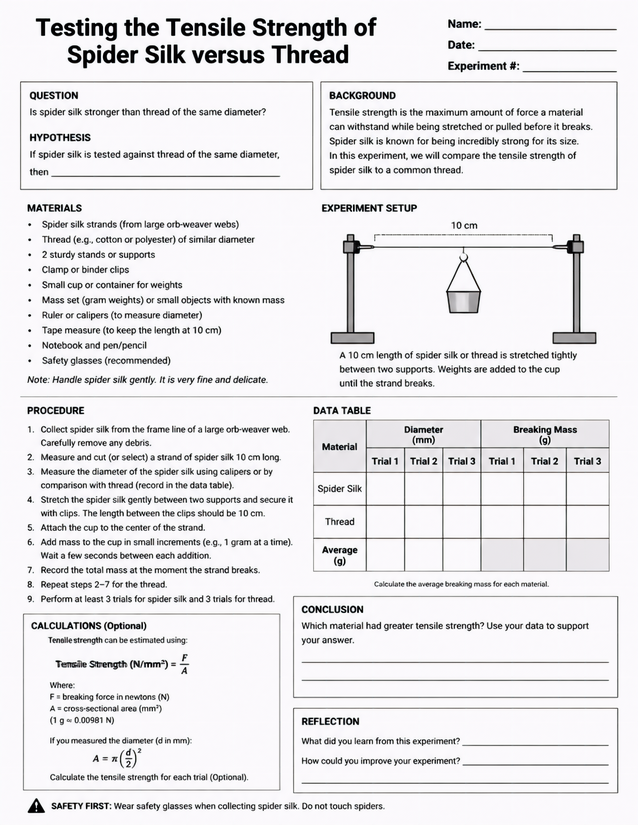
Record diameter and breaking mass across three trials with this spider silk tensile strength lab designed for homeschool grades 5-8.
Setting Up the Spider Silk Tensile Strength Lab

Usage Notes
Safety glasses are flagged as recommended on the sheet, and the procedure includes a note to handle spider silk gently because it is very fine and delicate. Students will need two sturdy stands with clamps or binder clips, a small cup for weights, and gram weights or small objects with known mass. Most materials are household items, but sourcing spider silk from a large orb-weaver web requires patience and outdoor access, so plan the collection step a day ahead.

Printing Tips
A 28-lb or heavier paper keeps the data table from warping if the sheet gets handled repeatedly during a multi-day experiment. Print one sheet per student and slip it into a plastic page protector at the front of a lab notebook, or keep it loose on a clipboard beside the apparatus for easy recording during each weight addition.