Creative Minds 𖹭 Happy Hearts

Static Electricity Balloon Experiment Lab Sheet
Paper bits jumping off a table and clinging to a balloon stop your student mid-sentence every time. This static electricity balloon experiment records exactly why that happens, from rubbing to electron transfer to charged attraction.
Rooted in the physics of electron transfer, this lab sheet walks grades 3-6 students through a complete scientific inquiry cycle. The question asks whether a charged balloon can attract small pieces of paper, the hypothesis section prompts students to commit to a prediction before touching a thing, and the six-step procedure guides them from tearing paper to moving the balloon at varying distances and recording what they observe across three separate trials.
The static electricity balloon experiment fits naturally into a unit on electricity, forces, or matter and energy for early middle elementary learners. It works as a standalone lesson or as an entry point before introducing concepts like electric fields or charge polarization. A student who completes the sheet, including the conclusion and extension prompts, can explain in their own words how rubbing transfers electrons and why a neutral object gets attracted to a charged one.
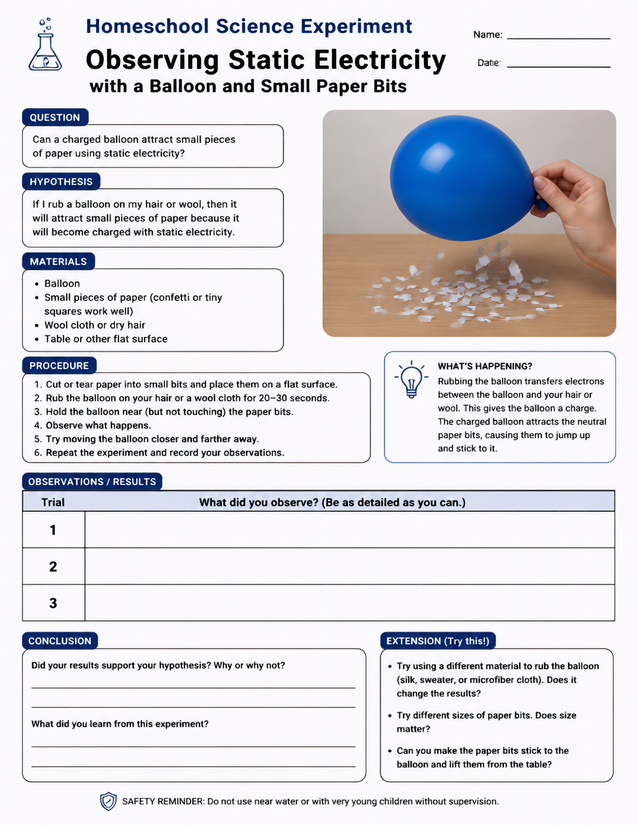
Grades 3-6 homeschoolers test whether a charged static electricity balloon experiment can lift paper bits using electron transfer.
Exploring the Static Electricity Balloon Experiment Step by Step

Usage Notes
Every material listed is a household item: a balloon, small torn paper bits or confetti, wool cloth or dry hair, and a flat surface. No specialty supplies are needed, which makes this one of the lower-friction labs to set up on a school morning. The sheet includes a safety reminder to keep the experiment away from water and to supervise very young children.

Printing Tips
Standard 20 lb copy paper works fine here since students write brief trial observations rather than extended notes. Slip the sheet into a plastic page protector and insert it into a science lab notebook, or keep it loose on a clipboard so it stays flat while your student moves the balloon back and forth across the table.