Creative Minds 𖹭 Happy Hearts

Syllable Types Overview Worksheet, Five Types in One Page
Five syllable types, four activity formats, and a color-coded reference chart: the syllable types overview worksheet covers a lot of ground in one tidy page.
The top half of the page serves as a self-contained reference, five color-coded boxes defining closed, open, vowel-consonant-e, r-controlled, and consonant-le syllables, each with a brief rule, a labeled example word, and a small illustration. A sleeping child, a racing car, a layered cake, a blue sedan, and a wooden table make the examples concrete and memorable.
Below the reference section, the syllable types overview worksheet moves into four practice activities: clapping and counting syllables for ten words, matching words to their syllable type by drawing lines, writing the syllable type from memory, and sorting a word bank into a five-column table. The progression moves from recognition to independent recall, making this a genuinely complete practice session rather than a single-skill drill.
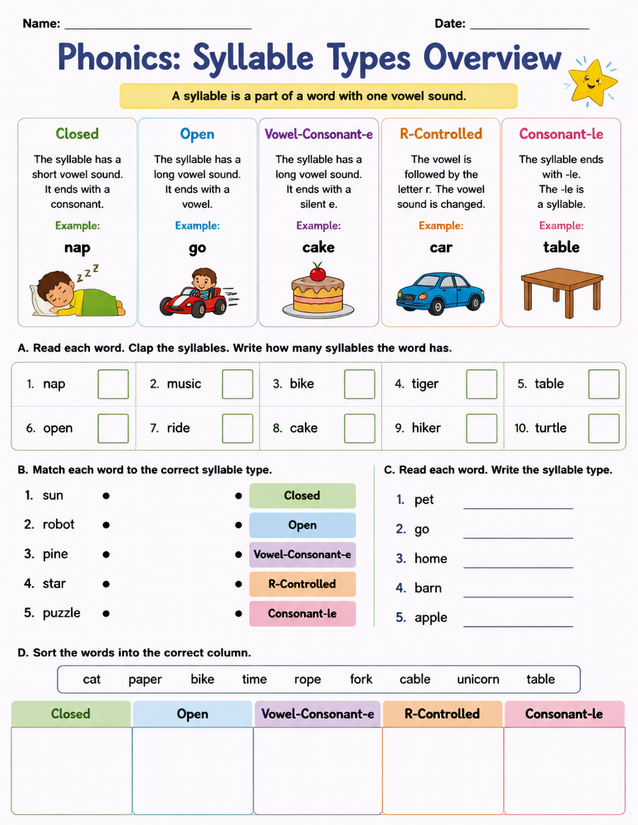
All five syllable types land on one syllable types overview worksheet, with matching, sorting, and counting activities included.
Where to Start with the Syllable Types Overview Worksheet

Usage Notes
Watercolor pencils work well for lightly tinting the five reference boxes without bleeding into the definition text. A fine liner in black is useful for tracing the bold example words to help younger learners focus on each word’s structure. Use alcohol markers cautiously on the sorting table at the bottom, since the thin activity lines can bleed if the marker tip is too broad.
Printing Tips
Standard 20 lb copy paper is fine here, but scaling to 105 percent before printing gives the four activity sections a little more breathing room for small handwriting, especially in the matching and sorting areas.