Creative Minds 𖹭 Happy Hearts

Telling Time to the Minute Worksheet, Read and Draw Clocks
Eight analog clocks, two skills, and a pair of word problems that make your student actually think about elapsed time. A telling time to the minute worksheet that covers more ground than a single drill.
Across three sections, your student reads clock hands and writes times precisely, then flips the skill by drawing hands onto blank clock faces for given times like 3:17, 8:42, 11:05, and 6:29. A word problems section at the bottom asks students to calculate elapsed time from a movie runtime and a morning commute, pushing them past clock-reading into applied reasoning. This telling time to the minute worksheet suits grades 2 and 3, and works well as part of a measurement and data unit study.
The read-and-write section builds minute-hand precision, while the draw-the-hands section reinforces the relationship between written time and clock position. The elapsed time problems add a layer that benefits from a brief guided walkthrough before independent completion, especially for students encountering elapsed time for the first time. Your homeschooler gets three distinct practice types on a single page.
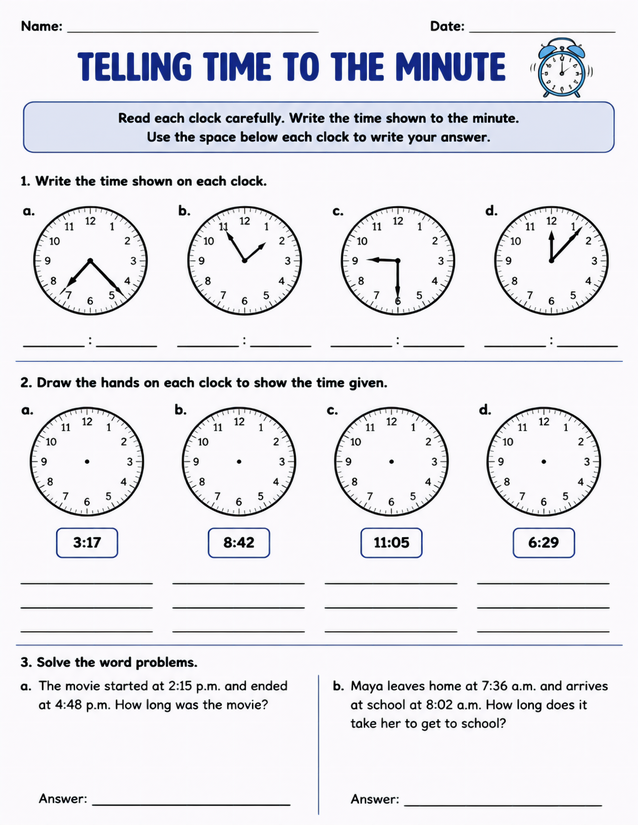
Read analog clocks, draw clock hands, and solve elapsed time word problems with this telling time to the minute worksheet for grades 2-3.
Getting Precise with a Telling Time to the Minute Worksheet

Usage Notes
A pencil works best here since your student draws clock hands and writes times that may need correcting. The hand-drawing section asks for careful placement, so encourage a light first mark before committing. Sections one and two suit independent practice once the concept is introduced, but section three works better with a short guided walkthrough first.

Printing Tips
Standard 20 lb copy paper is fine for pencil work. Portrait orientation is built into the layout, and the three sections fill the page cleanly. Printing two or three copies lets your student attempt the clock-drawing section more than once if the first pass needs refinement.