Creative Minds 𖹭 Happy Hearts

Temperature on the Rate of Diffusion, Homeschool Lab Sheet
Food coloring dropped into cold, room-temperature, and hot water tells a clear story. This lab sheet gives your student the structure to time it, record it, and explain why temperature on the rate of diffusion matters.
Your grades 5-7 student uses one color of food coloring dropped from a consistent height into three cups of water held at cold (5-10°C), room temperature (20-25°C), and hot (40-50°C) to observe how quickly particles spread. The sheet walks through a seven-step procedure, a two-trial data table with average time calculations, and five analysis questions that ask students to identify fastest and slowest diffusion rates, describe the relationship, and predict an outcome for a new scenario.
The temperature on the rate of diffusion experiment works as a standalone introductory lab or as part of a broader chemistry or physics unit on kinetic molecular theory and particle movement. Completing both trials and calculating the average time demonstrates basic experimental controls and data averaging, while the analysis section pushes your homeschooler from observation into explanation and scientific reasoning.
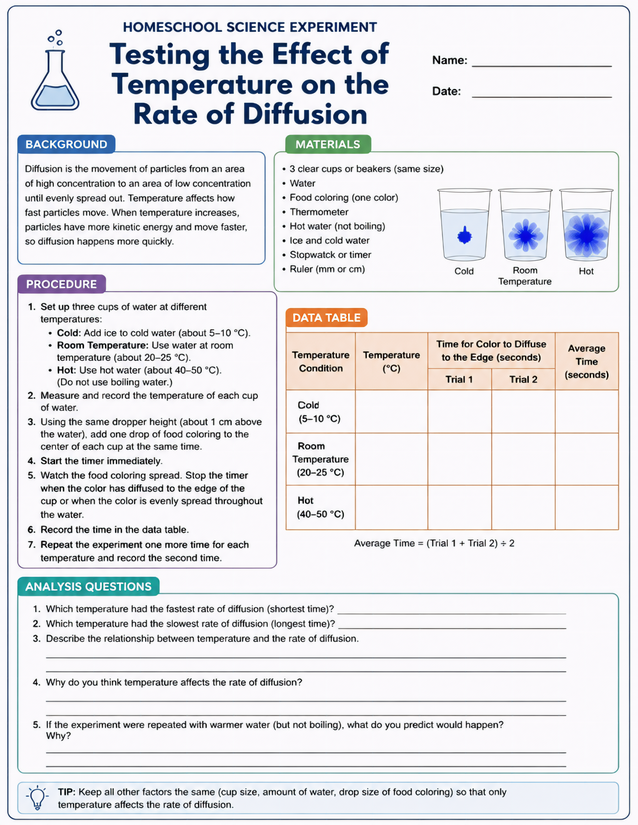
Grades 5-7 homeschoolers test temperature on the rate of diffusion using food coloring, water, and a timer. Instant download.
Investigating Temperature on the Rate of Diffusion Step by Step

Usage Notes
Everything on the materials list is a household staple except possibly a stopwatch or thermometer, both of which are low-cost if you need to pick them up. The procedure specifies water temperatures between 5°C and 50°C, so no boiling is involved, making this a low-risk lab for independent student work with minimal supervision. Three same-size clear cups or beakers, one color of food coloring, and a ruler round out the setup.

Printing Tips
Eighty-pound text stock or standard copy paper both hold up fine here since students are writing dry data, not handling wet samples directly. Punch holes along the left edge and slip it into a dedicated science lab notebook so the completed data table stays alongside your student’s other experiment records.