Creative Minds 𖹭 Happy Hearts

Temperature on the Viscosity of Motor Oil Lab Sheet
Motor oil flows like syrup in the cold and like water in the heat. This lab sheet walks your student through testing temperature on the viscosity of motor oil with a syringe, a bottle cap, and two water baths.
Your grades 5-7 homeschooler investigates how temperature on the viscosity of motor oil produces measurable differences in flow rate. The sheet walks through a clear sequence: preparing a modified bottle cap as an orifice, filling a syringe with SAE 10W-30, conditioning the oil at five temperatures (0, 20, 40, 60, and 80 degrees Celsius), and timing how long it takes the oil to drain. A built-in data table captures three trials at each temperature so students can calculate an average and spot the pattern themselves.
Three analysis questions push past the numbers. Students explain what the flow time data reveals about viscosity, connect their findings to how engines behave in cold versus hot weather, and draw a written conclusion. This works as a standalone unit study on fluid dynamics or as part of a broader chemistry or physics sequence on matter and molecular behavior. Completing the sheet demonstrates that a student can control variables, read a thermometer, use a stopwatch accurately, and reason from quantitative evidence to a real-world application.
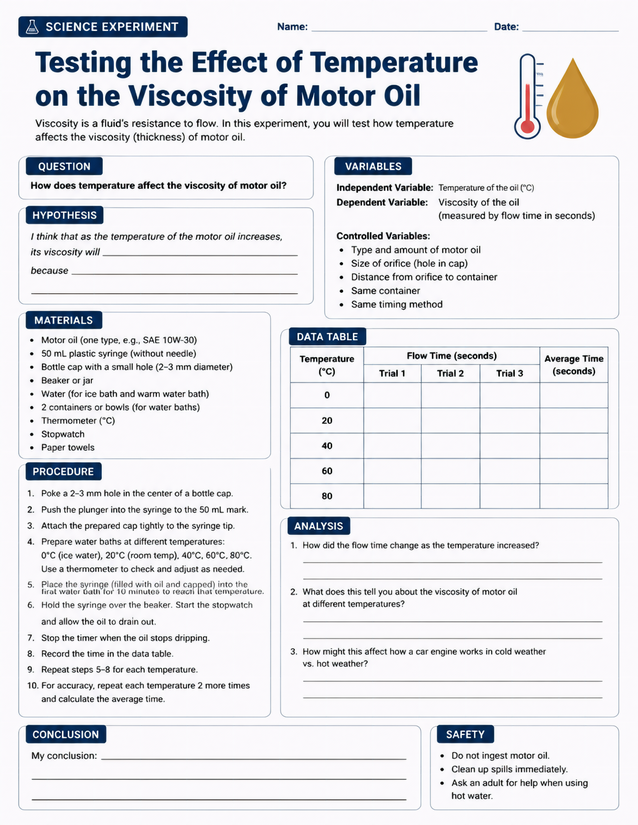
Grades 5-7 homeschoolers test temperature on the viscosity of motor oil across five heat levels, recording flow times in three trials.
Setting Up Temperature on the Viscosity of Motor Oil Experiment

Usage Notes
Motor oil (SAE 10W-30), a 50 mL plastic syringe without a needle, and a bottle cap with a 2 to 3 mm hole drilled in the center are the key supplies. Two containers for water baths (one cold with ice water, one warm) are household items, and a thermometer and stopwatch round out the kit. The safety section on the sheet flags three reminders: do not ingest the oil, clean up spills right away, and get an adult’s help when handling hot water.

Printing Tips
Regular copy-weight paper works for this sheet, but 28-pound paper holds up better if any oil drips land near it during the experiment. Punch the completed sheet into a lab notebook binder, or keep it as a loose page on a clipboard where it stays flat while your student works between water baths.