Creative Minds 𖹭 Happy Hearts

Temperature on Yeast Fermentation Lab Sheet, Four Water Baths
Four bottles, four water baths, one balloon on each: the temperature on yeast fermentation lab makes CO2 production visible in real time as balloons expand at different rates.
Your grades 5-7 student investigates how temperature changes the speed of yeast activity by placing four 500 mL bottles in water baths ranging from ice cold (0-10°C) to hot (50-55°C). A balloon stretched over each bottle inflates as the yeast produces carbon dioxide, and students measure the circumference of each balloon at the 0, 10, 20, and 30-minute marks, recording everything in the built-in data table.
The temperature on yeast fermentation lab fits naturally into a biology or chemistry unit study covering cellular respiration, living organisms, or variables in scientific experiments. Four analysis questions ask students to identify the fastest and slowest fermentation temperatures and explain what happens at extremes, and a conclusion section requires them to support their answer with actual data from the table rather than guessing. Completed on its own, the sheet demonstrates controlled variable design and evidence-based reasoning.
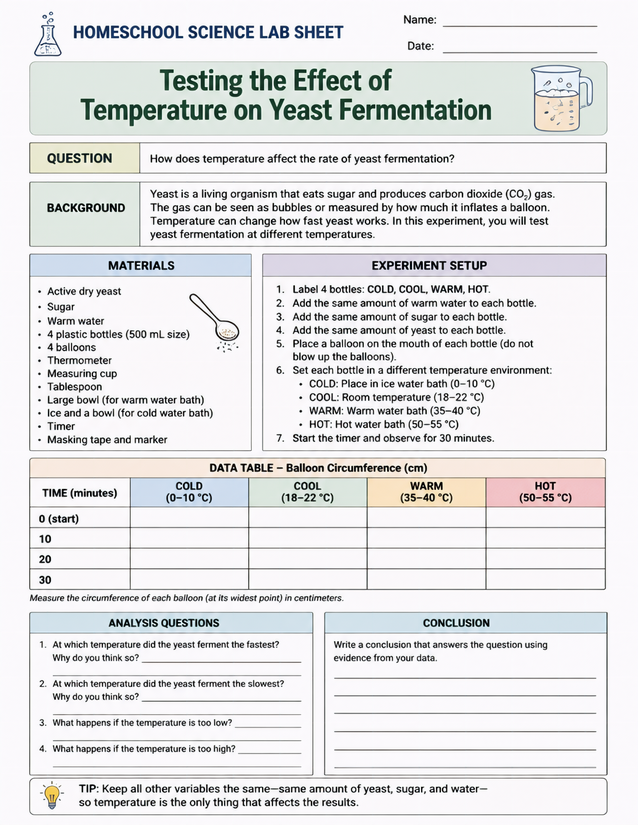
Grades 5-7 homeschoolers measure balloon circumference across four temperatures in this temperature on yeast fermentation lab. Instant download.
Investigating the Temperature on Yeast Fermentation Lab at Home

Usage Notes
Active dry yeast and sugar are pantry staples, but you will also need four 500 mL plastic bottles, four balloons, a thermometer, and both a warm water bath and an ice bath running simultaneously. The hot water bath (50-55°C) requires supervision, so review safe handling of warm water with your student before starting. A measuring tape for reading balloon circumference is the one tool families sometimes overlook.

Printing Tips
Standard copy paper is fine for a one-time run, but 32-pound paper takes pencil and pen better when students are recording measurements every ten minutes on a clipboard. Hole-punch the finished sheet to drop into a science binder or lab notebook once the 30-minute observation window is complete.