Creative Minds 𖹭 Happy Hearts

Testing the pH of Household Liquids with Cabbage Juice Indicator
Red cabbage turns your kitchen into a chemistry lab. Testing the pH of household liquids with cabbage juice gives your student a hands-on way to see acids and bases react in real time.
This lab sheet walks students through testing the pH of household liquids using a homemade cabbage juice indicator. The sheet covers background on anthocyanin pigments, a five-step procedure for preparing the indicator by simmering red cabbage in water, and a structured results table where students record the color observed, estimated pH, and whether each liquid is acidic, neutral, or basic. A built-in pH color guide spanning pH 1 through 14 gives students a reference for interpreting their results without additional materials. Designed for grades 4 through 7, this experiment is a natural fit for a chemistry or matter unit study.
The lab works well as a standalone experiment or as an entry point into a broader acids and bases unit. Students test common liquids such as lemon juice, vinegar, milk, baking soda solution, and tap water, then classify each one using their color observations. Completing the sheet demonstrates that your student can form predictions, conduct a controlled test, record qualitative data, and draw conclusions from physical evidence.
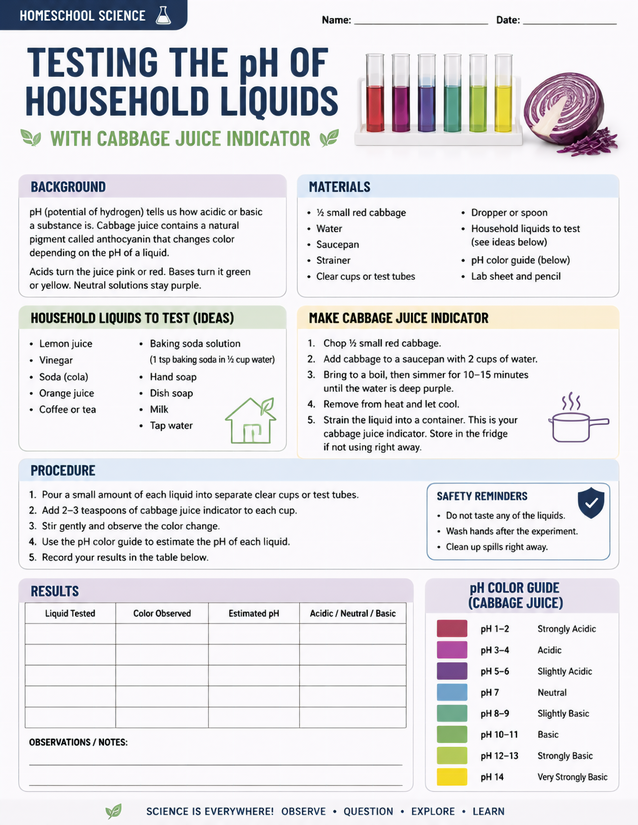
Grades 4-7 homeschoolers use cabbage juice for testing the pH of household liquids in this color-changing indicator experiment. Instant download.
Getting Started with Testing the pH of Household Liquids

Usage Notes
Nearly everything on the materials list is already in your kitchen. Red cabbage, water, a saucepan, a strainer, and clear cups or test tubes are all that is required to run the experiment. The safety reminders on the sheet flag three rules worth reviewing with your student before starting: no tasting the liquids, hand washing after, and immediate cleanup of spills.

Printing Tips
Copy paper works for this lab, but 24-lb paper holds up better if cups drip or hands are damp mid-experiment. Slip the sheet into a clipboard so your student can write while standing at the counter, or punch holes and file it directly into a science lab notebook after the results are recorded.