Creative Minds 𖹭 Happy Hearts

Testing Which Materials Conduct Electricity, Homeschool Lab Sheet
Coins, foil, and a wooden stick all go on trial here. Your student builds a real circuit and lets the light bulb give the verdict on testing which materials conduct electricity.
Structured for grades 3 to 6, this lab walks your student through building a simple series circuit with a 1.5V AA battery, a small light bulb in a holder, and two alligator clip wires. Each test material gets clipped into the circuit one at a time, and the bulb either lights up or it does not, producing a clear yes or no result recorded in the eight-row chart alongside predictions and notes. The conclusion section asks which materials conducted and which did not, pushing your student to synthesize observations rather than just report them.
Testing which materials conduct electricity works well as a standalone electricity introduction or as an early session in a broader unit study on circuits and energy. Completing the sheet demonstrates that your student can form a hypothesis, design a fair test, and distinguish conductors from insulators using observable evidence. The safety tip printed at the bottom reminds students to use only a battery and never a wall outlet, making it a low-risk hands-on lesson you can run at the kitchen table.
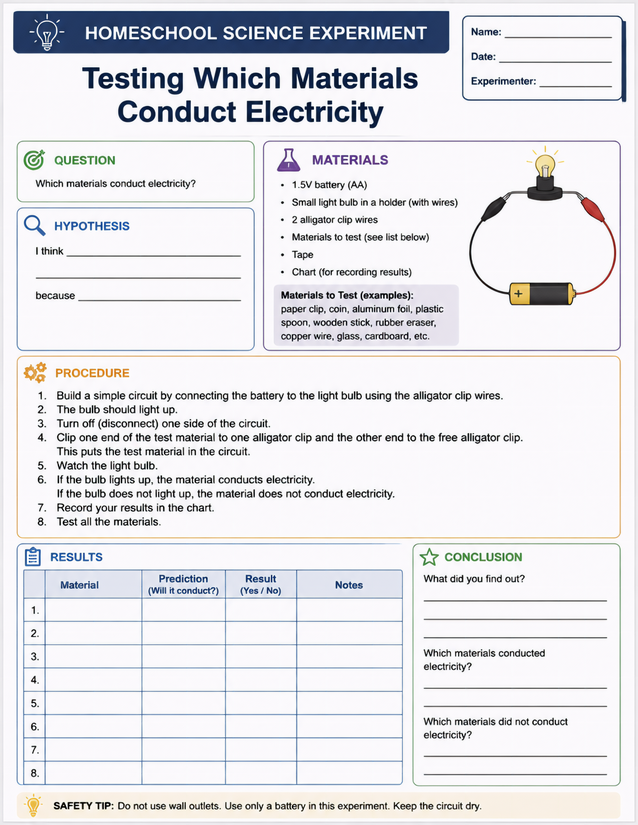
Grades 3-6 homeschoolers test conductors and insulators using a simple battery circuit. Download the testing which materials conduct electricity lab sheet free.
Investigating Testing Which Materials Conduct Electricity at Home

Usage Notes
Nearly everything on the materials list is already in a typical home: a AA battery, a coin, paper clip, aluminum foil, plastic spoon, wooden stick, rubber eraser, copper wire, cardboard, and tape. The one specialty item is a small light bulb in a holder with lead wires, available inexpensively at hobby or science supply stores. The safety note on the sheet is clear: wall outlets are off-limits, and the circuit must stay dry.

Printing Tips
Cardstock is not ideal here because students write frequently in the results chart during the experiment. A standard 20 lb copy-weight sheet sits flat on a clipboard and travels easily between the worktable and wherever test materials are staged. Slip the finished sheet into a three-ring lab notebook after the conclusion is complete.