Creative Minds 𖹭 Happy Hearts

Testing Which Type of Chocolate Melts Fastest, Science Lab
Dark, milk, or white chocolate on identical plates in a warm room: testing which type of chocolate melts fastest turns a snack aisle question into a repeatable, timed experiment your student can actually run.
Your student picks a hypothesis, then runs three timed trials comparing same-brand squares of dark, milk, and white chocolate placed on separate plates in a draft-free warm room. The sheet walks through each step of the procedure, records individual trial times in seconds, calculates an average, and ranks the chocolates from fastest to slowest. This lab is well-suited for grades 3-5 and builds core data-collection skills alongside an introduction to fair-test design.
Testing which type of chocolate melts fastest fits naturally into a unit study on states of matter, heat transfer, or properties of materials. It works as a standalone afternoon experiment or as one piece of a broader chemistry sequence. By the time your homeschooler fills in the Analyze and Think section, they have practiced identifying variables, evaluating fairness in experimental design, and drawing a conclusion supported by averaged numerical data.
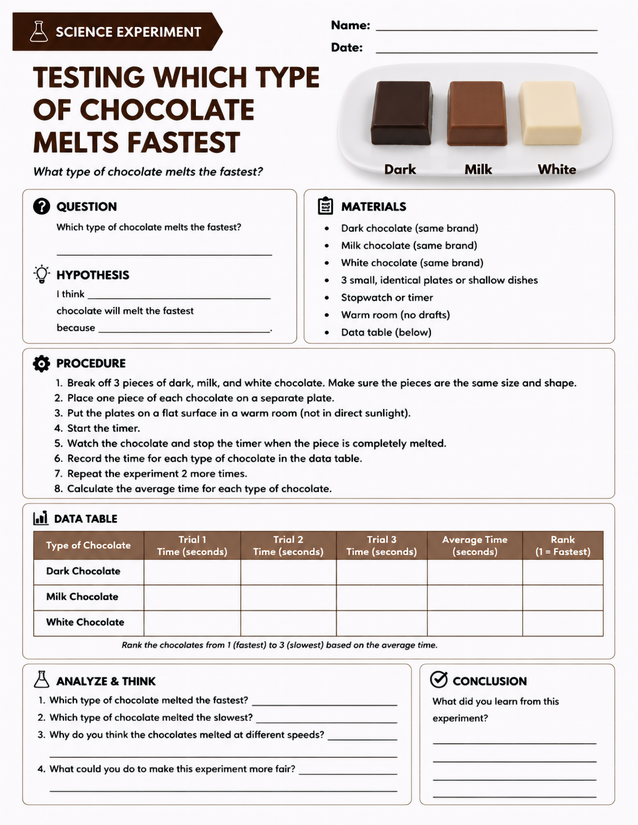
Dark, milk, or white: this testing which type of chocolate melts fastest lab sheet guides grades 3-5 homeschoolers through timed trials and data recording.
Investigating Testing Which Type of Chocolate Melts Fastest

Usage Notes
Chocolate squares of the same brand in all three varieties are the only specialty item here, and most grocery stores carry them in the baking aisle. Beyond that, three small plates, a stopwatch or phone timer, and a warm indoor spot away from drafts are all that is needed. No heat source is required, which keeps this experiment safe for independent student work.

Printing Tips
A 20 lb standard sheet works fine for desk use, but 24 lb paper holds up better if your student is recording times with a damp or chocolatey hand nearby. Slip it into a plastic page protector in a lab notebook so the data table stays flat and legible when you review results together.