Creative Minds 𖹭 Happy Hearts

Testing Which Type of Soil Retains the Most Water
Sand, loam, or clay: testing which type of soil retains the most water is a hands-on way to connect earth science to real gardening decisions your student can see firsthand.
Three jars, three soil types, and one measuring cup are all it takes to run a controlled water-retention comparison that builds genuine lab skills. The sheet walks grades 4-6 students through a full scientific method sequence: writing a hypothesis, identifying independent and controlled variables, following a nine-step procedure, and recording drainage measurements in a structured data table for sand, loam, and clay. After 30 minutes of drain time, students subtract drained water from the 240 mL poured to calculate exactly how much each soil held.
Testing which type of soil retains the most water fits naturally into an earth science or botany unit study, and the Think Further prompt at the bottom connects results to plant growth and gardening, extending the lesson beyond a single session. Completed alone, the sheet demonstrates that a student can design controlled variables, collect quantitative data, and draw an evidence-based conclusion. Paired with the soil pH or seed germination experiments in your curriculum, it builds a cohesive soil science sequence.
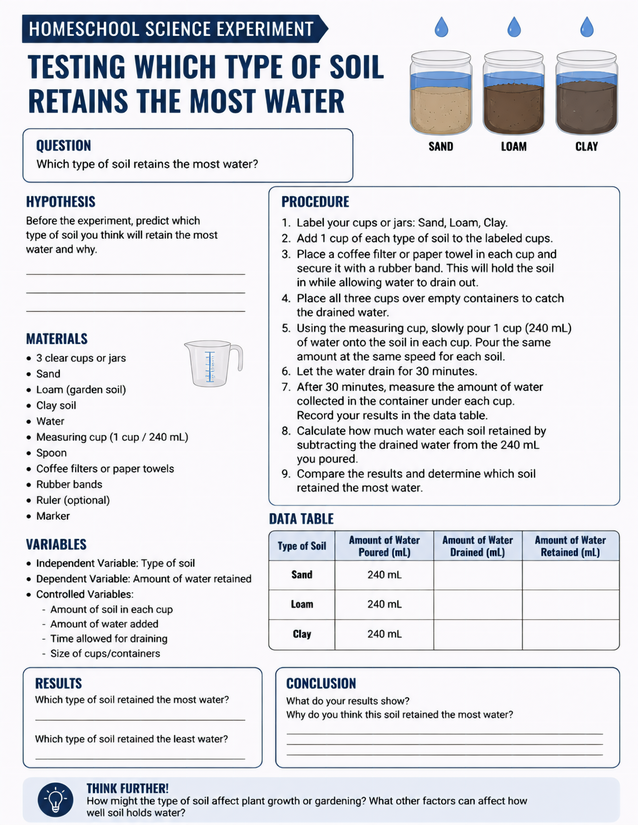
Sand, loam, and clay face off in this testing which type of soil retains water experiment, ideal for grades 4-6 homeschoolers.
Getting Started with Testing Which Type of Soil Retains Water

Usage Notes
All materials here are household or garden-shed basics: clear cups or jars, sand, loam, clay soil, a measuring cup, coffee filters or paper towels, rubber bands, and a spoon. No specialty lab supplies are needed, though access to all three distinct soil types may require a quick trip to a garden center if loam or clay are not already on hand. Water is poured slowly from height, so working over a sink or with containers placed on a tray reduces spill risk.

Printing Tips
Standard 20 lb copy paper works for a single-use lab session, but 24 lb paper holds up better if cups or hands are damp during recording. Slide the completed sheet into a lab notebook or a plastic page protector at the end of the lesson to keep the data table readable for later review and comparison.