Creative Minds 𖹭 Happy Hearts

Tropical Rainforest Food Web Coloring Page, Jaguar to Decomposers
Eleven species, one jaguar at the top, and a web of arrows that finally makes trophic levels make sense. Your tropical rainforest food web coloring page comes with every relationship already labeled.
Producers line the bottom row: fruiting plants, leaves and shoots, flowers for nectar, seeds and nuts, and fungi with bacteria doing decomposer duty at the far right. Above them, a toucan, tree frog, butterfly, lizard, small bird, sloth, and tree snake each carry a diet label, and every arrow is typed as ‘eats,’ ‘is eaten by,’ or ‘competes with’ using the key in the top corner. A lush border of tropical leaves, monstera fronds, and flowers frames the whole thing without crowding the diagram.
This tropical rainforest food web coloring page sits in the Color and Learn Infographics collection, and it earns that label because the arrows genuinely teach, not just decorate. Colorists who assign one color family per trophic level will find the layout rewards that system naturally. The mix of large animal silhouettes and fine botanical detail keeps the session interesting rather than repetitive.
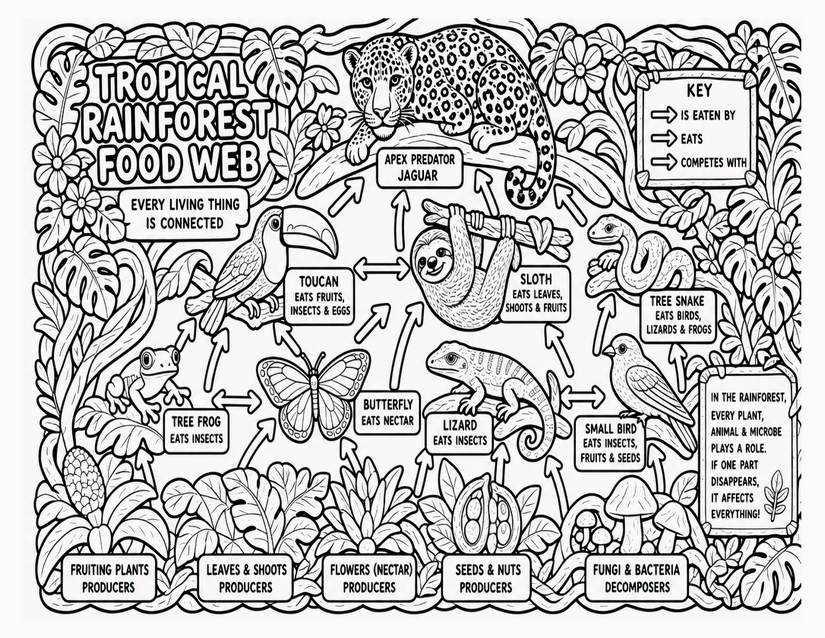
Grab the tropical rainforest food web coloring page and color eleven species across four trophic levels. Free instant download, print-ready.
Bonus Colorized Version for Inspiration
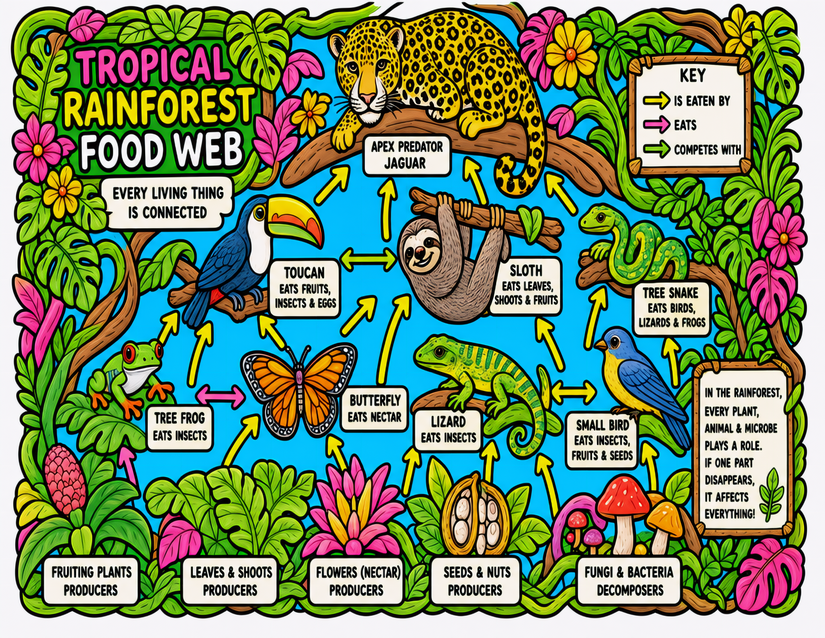
Best Tools for the Tropical Rainforest Food Web Coloring Page

Usage Notes
Colored pencils are worth reaching for first on the animal bodies, where layering lets you build the jaguar’s spots or the sloth’s fur without muddying the labeled boxes nearby. Watercolor pencils work well on the wide botanical border, where the leaf shapes are roomy enough to blend freely. Use fine liners cautiously around the arrow diagrams if you want to retrace labels after coloring, since any bleed onto the text boxes will obscure the food web key.

Printing Tips
Landscape orientation is essential here. The diagram is wider than it is tall, and printing portrait will either clip the producer row or shrink the whole infographic below readable label size. A 28 lb or heavier copy paper prevents the dense botanical border from ghosting through to the back.