Creative Minds 𖹭 Happy Hearts

Two-Step Subtraction Word Problems, Three Real-World Scenarios
Books, apples, and soccer teams: these two-step subtraction word problems give your student a real reason to subtract twice before writing a final answer.
Each of the three problems on this sheet requires two separate subtraction steps before reaching the final answer. Problem one tracks books read and given away from a shelf of 86. Problem two has students calculate apples picked across two time periods, then subtract those sold. Problem three works with student counts and a soccer team roster. Labeled Step 1 and Step 2 boxes guide the work, with a dedicated answer box at the end of each problem. This homeschool worksheet is well matched to grades 2 through 3, where multi-step reasoning is just beginning to develop.
These two-step subtraction word problems work well as a guided lesson the first time through, since the two-step structure can catch students off guard if they rush to a single calculation. Once your student understands how to identify what each step is asking, the sheet handles independent practice cleanly. Reading comprehension plays a quiet but real role here: your homeschooler must parse which numbers belong to which step before any arithmetic begins.
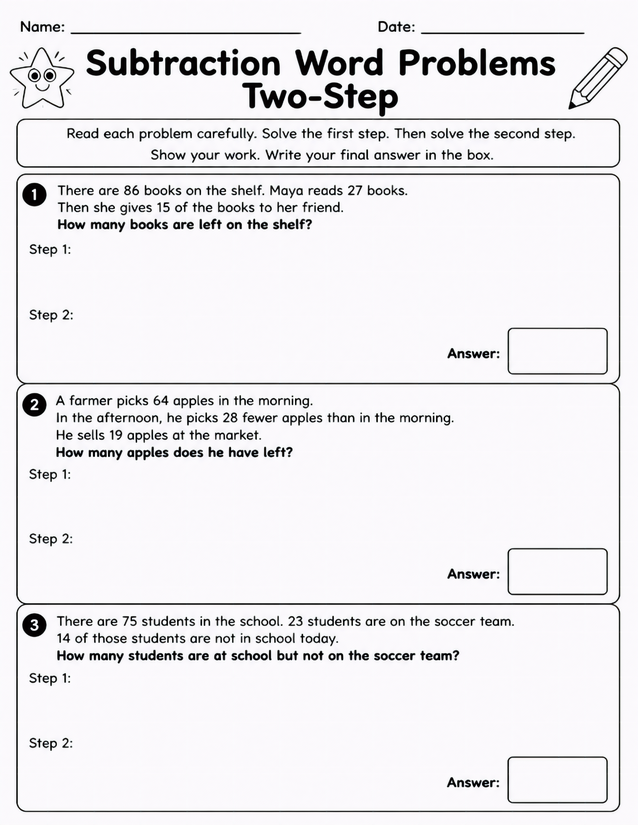
Grades 2-3 homeschoolers practice two-step subtraction word problems across three real-world scenarios. Each problem shows work space and an answer box.
Practicing Two-Step Subtraction Word Problems, Step by Step

Usage Notes
Pencil is the right call here so students can revise work between steps without the page getting cluttered. The two labeled work areas per problem give enough room for written calculations or simple number sentences. Guided instruction works best on first use, especially for students new to problems that require holding an intermediate answer before subtracting again.

Printing Tips
Portrait orientation on standard copy paper keeps all three problems readable at full size. Printing two or three copies lets your student attempt the problems independently on a second pass after working through them together once.