Creative Minds 𖹭 Happy Hearts

UV Light Effect on Bacteria Growth Lab Sheet
Four Petri plates, one UV lamp, and a timed sequence from zero to ten minutes: this lab makes the UV light effect on bacteria growth something your student can see and count firsthand.
Your grades 6-8 homeschooler investigates how increasing UV exposure time changes the number of bacterial colonies that survive. The sheet walks through labeling four Petri plates at 0 min (control), 1 min, 5 min, and 10 min intervals, inoculating each with a sterile swab, and then incubating all plates for 24 to 48 hours before counting colonies. The data table captures both colony count and observations like size and density at each exposure level, so your student is recording quantitative and qualitative results side by side. Testing the UV light effect on bacteria growth this way gives a clear visual gradient that makes the concept click.
This experiment fits naturally into a microbiology or environmental health unit study, and it pairs well with lessons on sterilization, food safety, or the electromagnetic spectrum. The analysis section asks three questions: what happened to colony count as exposure increased, what that reveals about UV radiation and bacteria, and how the information applies in real life. Those prompts move your student from observation into reasoning, which is exactly what a lab conclusion should do. It works as a standalone two-day experiment or as part of a longer sequence on factors that inhibit microbial growth.
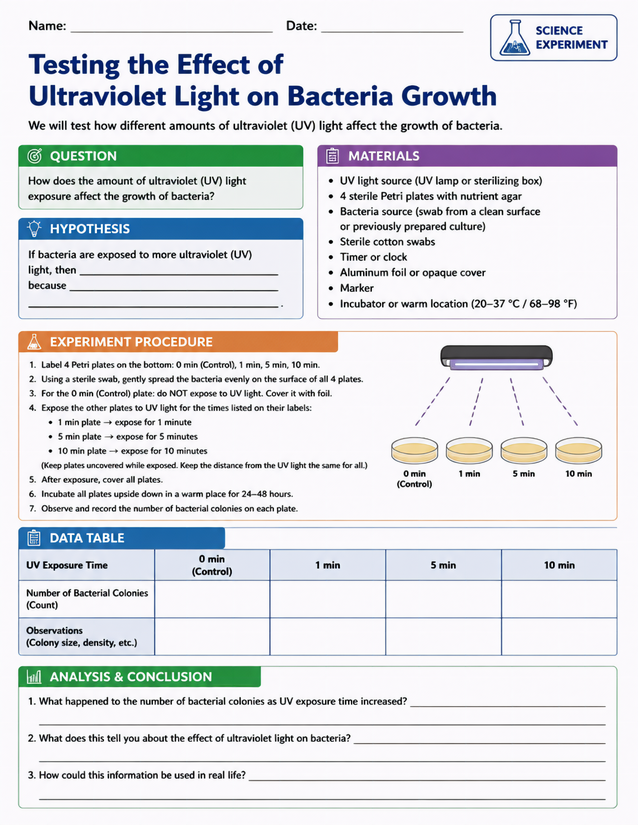
Grades 6-8 homeschoolers test the UV light effect on bacteria growth across four timed exposures. Instant download, ready to print.
Investigating the UV Light Effect on Bacteria Growth Step by Step

Usage Notes
Sterile cotton swabs, aluminum foil, and a marker are household staples, but this experiment does require specialty supplies: four Petri plates with nutrient agar, a UV lamp or sterilizing box, and an incubator or reliably warm location held between 20 and 37 degrees Celsius. The sheet flags a safety note worth passing along to your student: keep a consistent distance from the UV lamp and avoid looking directly at it during exposure. Source the Petri plates through a homeschool science supplier or a basic microbiology kit.
Printing Tips
Copy-weight paper handles the writing load fine for the data table and analysis questions. Punch holes along the left edge and slip it into a dedicated science lab notebook so colony count results stay next to any photos your student takes of the plates after incubation.