Creative Minds 𖹭 Happy Hearts

Vinegar on Egg Shells Lab Sheet, Rubbery Egg Experiment
Raw eggs plus white vinegar equals a bouncy rubbery egg, and this vinegar on egg shells lab sheet walks your student through every step of finding out why.
Designed for grades 3-5, this vinegar on egg shells lab sheet guides your homeschooler through a seven-day chemical reaction experiment comparing one vinegar-soaked egg against a water-soaked control egg. Students record daily observations in a structured table with separate columns for the vinegar egg, the water egg, and notes, then answer a bounce observation question and three written conclusion prompts about what happened to the shell and why.
The experiment fits naturally into a unit study on chemistry, acids and bases, or biology of animal cells. It works as a standalone multi-day project or as a hands-on complement to a lesson on chemical reactions and calcium carbonate. Completing the full sheet demonstrates your student’s ability to form a hypothesis, maintain a daily observation log, and draw a conclusion from firsthand evidence rather than from a textbook.
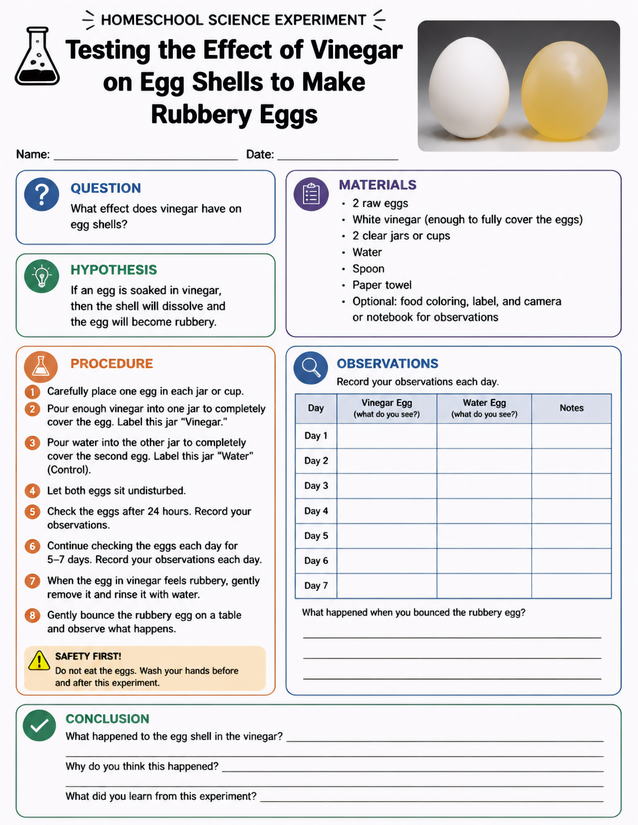
Record daily observations with this vinegar on egg shells lab sheet, designed for homeschool grades 3-5. All household materials included.
Recording Results for the Vinegar on Egg Shells Lab Sheet

Usage Notes
Every material on this sheet is a household item: two raw eggs, white vinegar, two clear jars or cups, water, a spoon, and a paper towel. Optional additions listed are food coloring, labels, and a camera or notebook for extra documentation. No safety equipment is required, though the sheet includes a printed reminder to wash hands before and after and not to eat the eggs.
Printing Tips
Sixty-pound or heavier paper holds up better when students write across seven consecutive days, since the sheet will sit out on a counter or table for up to a week. Slip it into a plastic page protector if you want to protect it from accidental splashes near the jar setup, but leave it loose so your student can write on it daily without removing it.