Creative Minds 𖹭 Happy Hearts

Water Types on Plant Growth Lab Sheet, 14-Day Observation
Four pots, four water sources, fourteen days of data: the water types on plant growth lab gives your student a front-row seat to one of botany’s most tangible variables.
Your student grows four identical seedlings side by side, watering each with a different source: tap, filtered, distilled, or salt water. The sheet walks through hypothesis writing, a daily height measurement table spanning days one through seven and day fourteen, and an observations column tracking leaf color, wilting, and other visible changes. Designed for grades 4-6, this water types on plant growth lab builds real data-collection habits across a two-week window.
The experiment works as a standalone unit or slots cleanly into a broader botany or earth science study. Because every variable except water type stays controlled, your homeschooler practices the logic of a fair test alongside the biology. Completing the conclusion section, where students circle whether their hypothesis was supported and answer a think-further prompt about other liquids they could test, pushes them past observation into genuine scientific reasoning.
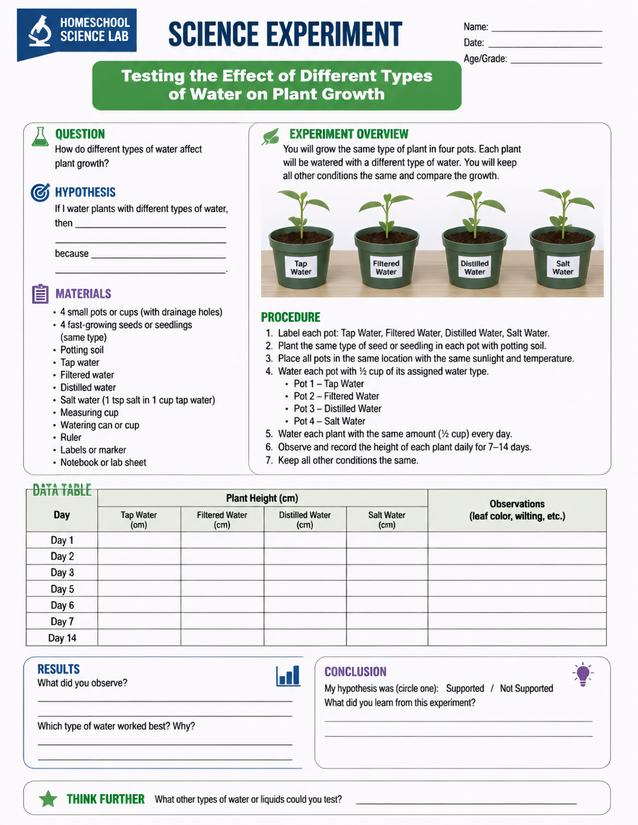
Grades 4-6 homeschoolers compare tap, filtered, distilled, and salt water using this water types on plant growth lab over fourteen days.
Getting Started with the Water Types on Plant Growth Lab

Usage Notes
Potting soil, four small pots with drainage holes, fast-growing seeds or seedlings, a measuring cup, and a ruler are the core supplies. Tap and distilled water are easy household sourcing; filtered water requires a pitcher filter or store-bought bottle, and salt water is mixed on-site at one teaspoon per cup. Salt water carries no safety concern, but remind your student to keep it clearly labeled so plants are not accidentally switched.

Printing Tips
Twenty-four pound paper is worth it here since students write in the data table daily and pencil pressure can ghost through lighter stock. A single printed sheet slipped into a plastic page protector inside a lab notebook keeps it flat and legible through the full fourteen days without laminating.