
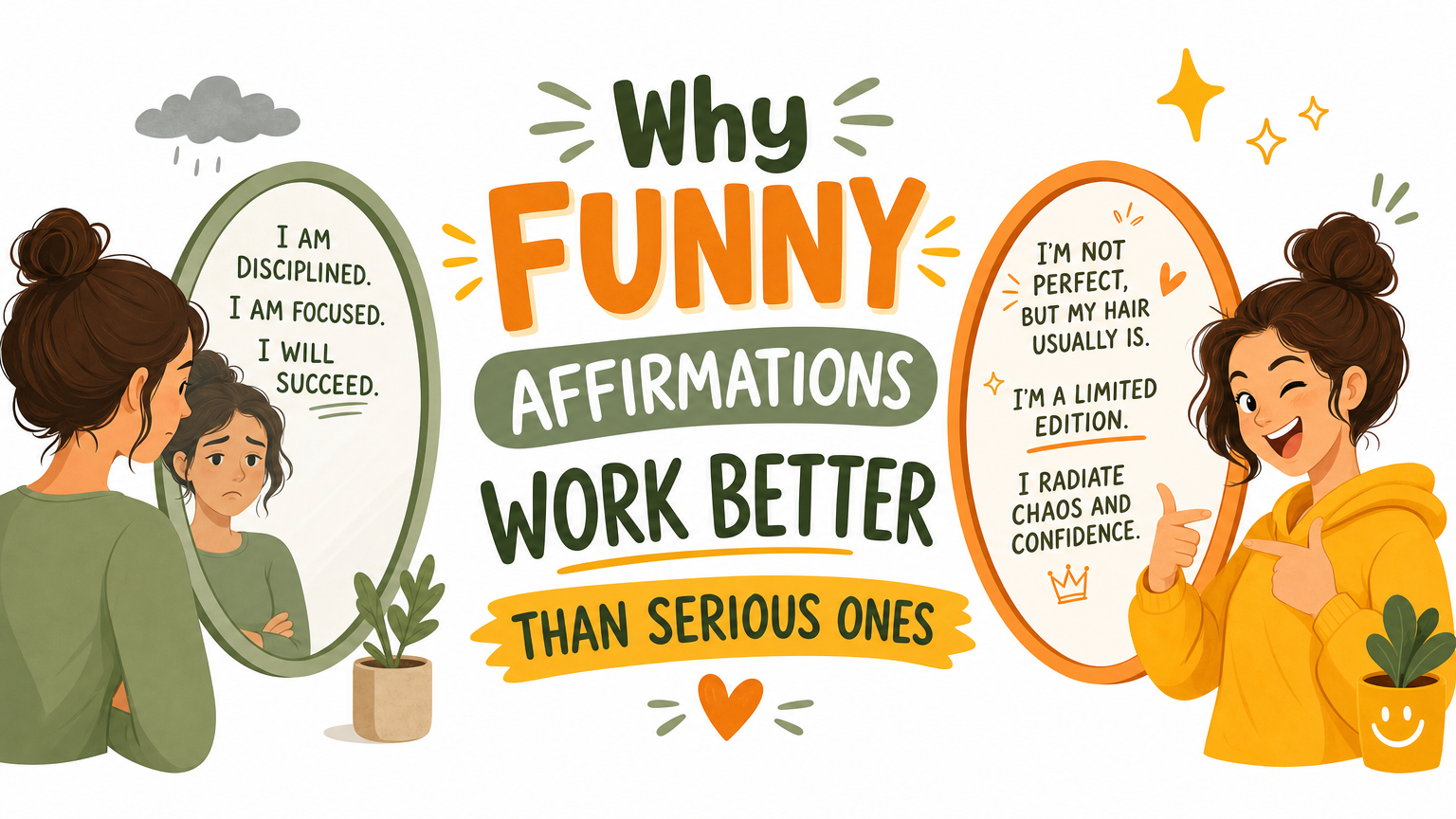
(And Yes, Science Said So)
Let’s be honest for a second.
You’ve seen the affirmations. The ones in flowing script on a pastel background, earnestly informing you that you are a radiant beam of light and your potential is limitless and today is going to be absolutely magical.
And somewhere deep in your soul, a tiny voice whispered: “Is it though?”
You are not broken. That little voice is actually your brain doing exactly what brains do. And it turns out, the funny affirmation hanging next to it — the one that says something like “I woke up. That counts.” — is probably doing a whole lot more good than its inspirational neighbor.
Here’s why…
Your Brain Is a Terrible Audience for Sincerity
Psychologists have a name for what happens when someone tells you something you are not quite ready to believe: psychological reactance. It is basically your brain’s bouncer showing up at the door and saying “not tonight.”
When a serious affirmation lands and it does not match how you actually feel, your brain argues back. The more forcefully the affirmation insists you are worthy and glowing and unstoppable, the harder your brain pushes in the opposite direction. It is less “positive thinking” and more “debate club.”
Humor sneaks past the bouncer entirely. Your brain is too busy being amused to mount a counterargument. A funny affirmation does not make a grand claim your inner critic can shoot down. It just makes you snort a little, and suddenly the moment is lighter than it was ten seconds ago.
Mission accomplished, frankly.
Distance Is Actually Your Friend
Researcher Ethan Kross at the University of Michigan has spent a lot of time studying how people process difficult emotions, and one of his more counterintuitive findings is that a little distance helps more than intense direct engagement.
In other words, diving headfirst into your feelings and staring them down is not always the most effective strategy. A small buffer allows some perspective, some breathing room and actually lets your brain do better work.
Humor creates that buffer naturally. When you laugh at a situation, you are stepping slightly outside of it. You are not dismissing your feelings. You are just not marinating in them either. That is a genuinely useful place to be.
Funny Breaks the Loop
Here is something inconvenient about human brains: they are wired to prioritize negative thoughts. This is called negativity bias, and it was very handy when our ancestors needed to remember which berries were poisonous. It is considerably less handy at 7am on a Tuesday when your brain has decided to replay every awkward thing you said in 2014.
Humor interrupts that loop. Not by pretending the loop does not exist, but by giving your brain something else to grab onto for a second. A genuinely funny affirmation breaks the cycle in a way that solemn inspiration simply cannot when you are standing in your kitchen in yesterday’s socks wondering how it all came to this.
It Has to Feel True to Work at All
Back in 1988, a psychologist named Claude Steele (yes, an actual Claude) laid out what became known as self-affirmation theory. The short version: affirmations only work when the person saying them actually believes them on some level.
This is the quiet little flaw in the whole serious-affirmation industry. If you do not feel like a radiant, limitless force of nature right now, repeating that you are one is not going to do much. Your brain knows the difference between a thing that resonates and a thing that is just noise.
Funny affirmations tend to resonate because they are rooted in honesty. “I survived everything so far” is technically true. “I did not quit, and honestly that deserves recognition” is technically true. There is no internal argument to be had. The affirmation lands because it is not asking you to believe something you do not believe. It is just reminding you of something real, with a wink.
So What Does This Mean for You?
It means your coloring time is not just a creative outlet. It is also, apparently, a psychologically sound coping strategy.
If you have been reaching for the funny, sassy, “this is my real life and I am choosing to laugh about it” pages over the earnest ones, your instincts are solid. Your brain was onto something.
And if you have not discovered the Real Lifermations collection yet, now seems like an excellent time. More than 50 funny and sassy affirmations coloring pages, designed for everyone who is tired of pretending they woke up radiant. Free therapy. Colored pencils not included.
Because sometimes the most honest thing you can say to yourself is also the funniest. And apparently that is exactly what your brain needed to hear.