Creative Minds 𖹭 Happy Hearts

DNA Double Helix Model Lab Sheet, Beads and Base Pairs
Colored beads and pipe cleaners become a working DNA double helix model lab sheet that teaches base-pairing rules through building, not memorizing.
Structured around a hands-on bead construction activity, this lab sheet walks your student through building a physical DNA double helix to understand how genetic information is stored in a molecule. The background section explains the sugar-phosphate backbone and nitrogen base pairs, with a color-coded reference key assigning green to Adenine, yellow to Thymine, orange to Cytosine, and purple to Guanine. Students record three written observations about their finished model and answer questions about what would happen if a base were paired incorrectly. It suits grades 6 to 8 in a homeschool life science or biology unit.
The DNA double helix model lab sheet fits naturally into a genetics or molecular biology unit study, either as an introduction to DNA structure or as a follow-up to a lesson on chromosomes. Three Think and Apply questions push your student beyond building to explain why DNA structure matters across organisms, making the sheet a complete standalone lesson rather than just an assembly activity. A challenge prompt at the bottom asks students to extend their model to 20 or more base pairs using a deliberate pattern, which deepens understanding of complementary base sequencing.
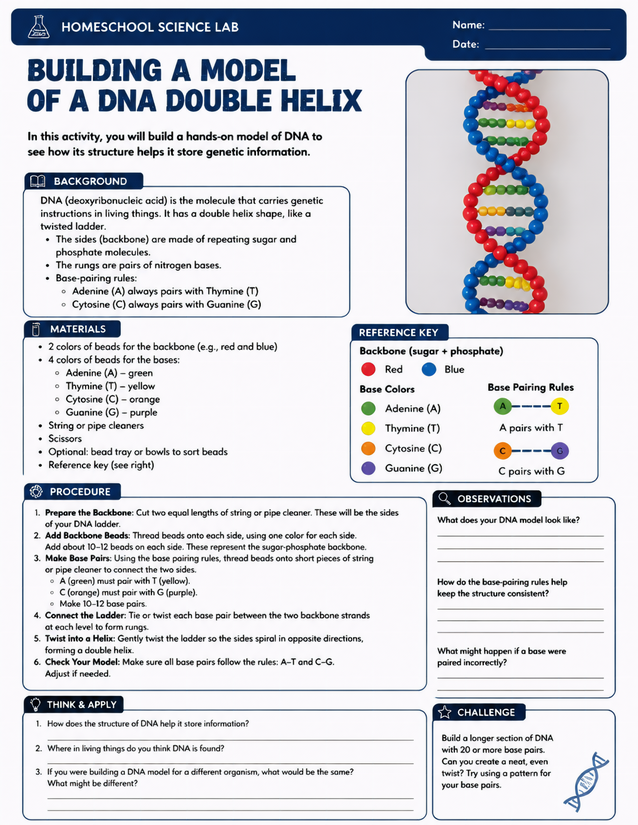
Build a bead-based DNA double helix model lab sheet for grades 6-8 homeschoolers. Color-coded base pairing included.
Getting Started with Your DNA Double Helix Model Lab Sheet

Usage Notes
Beads in six colors are the core supply: two colors for the backbone and four for the bases. String or pipe cleaners, scissors, and optional sorting bowls round out the list. All materials are household or craft-store basics, with no specialty lab supplies needed, though scissors should be supervised with younger students.
Printing Tips
Cardstock in the 65 lb range keeps the sheet flat on a work surface when beads and string are being handled nearby. A loose sheet on a clipboard works well during the building phase, and the observation lines are sized for pencil notes made mid-activity rather than after the fact.