Creative Minds 𖹭 Happy Hearts

Building a Model of the Food Web in a Local Ecosystem
Arrows linking algae to zooplankton to bluegill to heron: building a model of the food web makes energy flow visible in a way no textbook diagram quite manages.
Your student begins by choosing a local ecosystem, whether a pond, forest, backyard, or stream, then researches the organisms living there and records them on index cards or sticky notes color-coded by role: green for producers, blue for consumers, brown for decomposers. The sheet walks through six numbered procedure steps, from observation and research through arranging cards, connecting them with string or yarn to show who eats whom, and presenting the finished model. A built-in pond food web diagram, showing relationships among aquatic plants, algae, zooplankton, dragonfly nymphs, pond snails, bluegill, green frogs, painted turtles, largemouth bass, and a great blue heron, gives your student a concrete reference before building their own. This lab sheet suits grades 4 to 6 and pairs naturally with a broader ecology unit study.
Building a model of the food web moves your homeschooler from passive reading to active construction, requiring them to identify producers, consumers, and decomposers and then defend the connections they draw. Four open-ended reflection questions ask which organism has the most food sources, what happens if one organism disappears, and what the completed web reveals about interdependence. Extension ideas push further into comparing two ecosystems side by side or researching how human activity such as pollution or invasive species disrupts the web, giving you natural hooks into environmental science or current events.
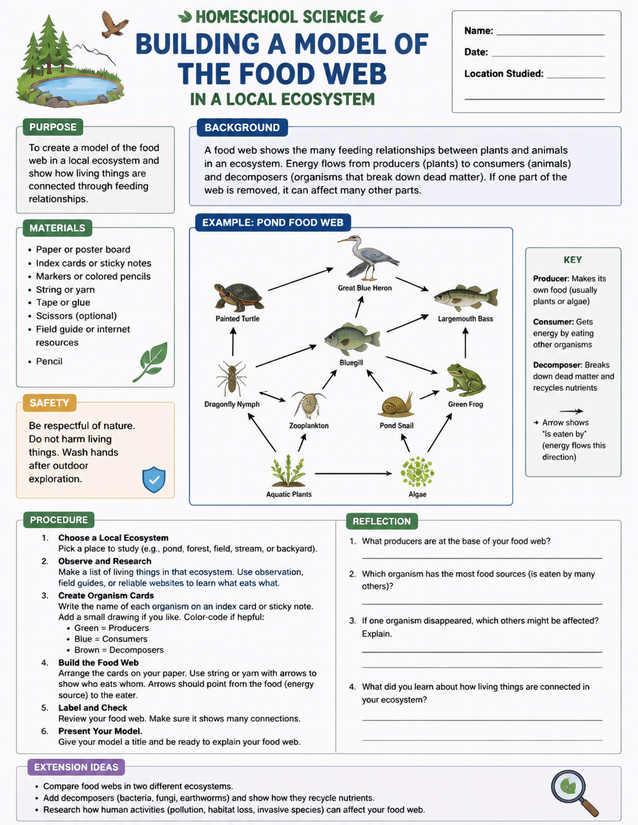
Grades 4 to 6 homeschoolers explore feeding relationships by building a model of the food web using cards, string, and arrows.
Investigating Building a Model of the Food Web

Usage Notes
Most materials here are household or classroom staples: paper or poster board, index cards or sticky notes, markers or colored pencils, tape or glue, and scissors. String or yarn is the one item worth hunting down before the session, since it physically represents the feeding arrows. The safety note on the sheet reminds students to respect living things during outdoor observation and to wash hands after any field exploration.
Printing Tips
A single sheet on 24 lb copy paper holds up well for the recording portion, but if your student is also gluing index cards to poster board for the model itself, keep those two surfaces separate. Slip this worksheet into a science lab notebook for reference while the physical food web model dries.