Creative Minds 𖹭 Happy Hearts

Insect Adaptations Lab Sheet, Observation Table Included
Magnifying glass in hand, your student is about to notice things about insects they have walked past a hundred times. This insect adaptations lab sheet turns a backyard bug into a biology lesson.
Designed for grades 3 to 6, this insect adaptations lab sheet walks your student through a structured observation of one or more insects, either live or from pictures. The guided question at the top sets the purpose: how do insects survive in their environments? Students record the insect’s name, habitat, physical adaptations such as body parts, color, and shape, behavioral adaptations, and how each feature aids survival. Four analysis questions at the bottom push thinking further, asking which adaptation was most interesting, how adaptations help survival, where the insect might struggle, and what the student learned overall.
This sheet works well as a standalone nature study lesson or as part of a broader unit study on animal adaptations, ecosystems, or entomology. A Charlotte Mason homeschool approach pairs naturally here since the sheet centers on careful firsthand observation before any labeling or classification. Completing the insect adaptations lab sheet demonstrates that your student can distinguish physical from behavioral traits and connect specific features to survival functions, a foundational biology skill that carries forward into ecology and life science.
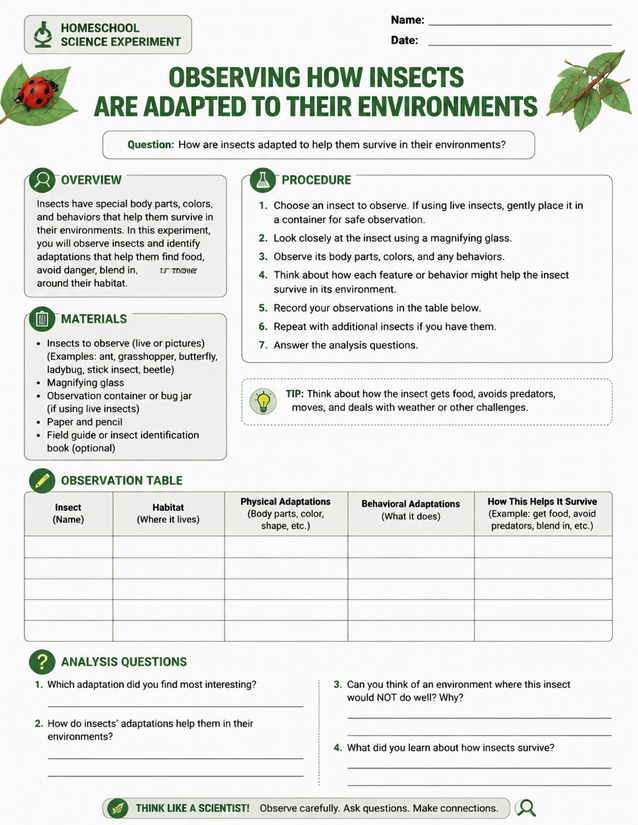
Your grades 3-6 homeschooler examines physical and behavioral insect adaptations using this insect adaptations lab sheet with a structured observation table.
Getting Started with the Insect Adaptations Lab Sheet

Usage Notes
Most materials on this sheet are household or backyard items: the insects themselves can be live specimens placed in a bug jar or simply pictures from a field guide or printed reference sheet. A magnifying glass is the one specialty tool listed, though an inexpensive plastic hand lens works fine. No chemicals or heat sources are involved, so this is a low-safety-concern lab suitable for independent student work outdoors.
Printing Tips
Standard 20 lb copy paper holds up fine for pencil notes at the observation table, but 24 lb paper keeps the sheet from buckling if your student is writing outdoors. Slip it into a clipboard for fieldwork, or insert a completed copy into a science lab notebook alongside any insect sketches your student adds.