Creative Minds 𖹭 Happy Hearts

Plants Communicate Through Underground Fungi Science Experiment
Underground fungal networks connecting plant roots sound like science fiction until your student runs the actual numbers. This lab on whether plants communicate through underground fungi puts that hypothesis to the test with four pots and a salt-stress trigger.
Students investigate whether plants communicate through underground fungi by setting up two plant pairs, one with mycorrhizal inoculant mixed into the soil and one without. A clear plastic barrier prevents root contact between plants in each pair, so any response in the receiver plant must travel through the fungal network. Salt dissolved in water is applied as a stressor to one plant in each pair, and students measure height and observe leaf color, wilting, and growth changes daily for seven days. The sheet is well-suited for grades 5-7 and walks students through labeling four pots (A, B, C, D), mixing inoculant only into the test group, and recording observations in a structured data table.
As a unit study anchor, this plants communicate through underground fungi experiment pairs naturally with lessons on symbiosis, soil ecology, or mycology. The analyze-your-results section asks students to compare the receiver plant in the fungal pair against the receiver in the control group, then draw a conclusion about the role of fungi in plant communication. Completing the sheet demonstrates a student’s ability to design a controlled experiment, isolate a single variable, and interpret multi-day observational data rather than a single-point result.
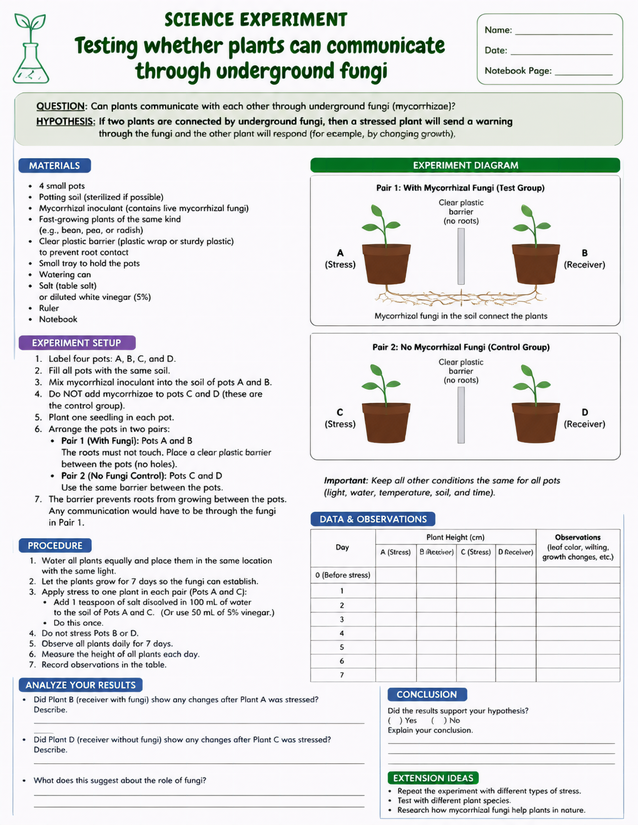
Can plants communicate through underground fungi? This grades 5-7 homeschool experiment uses mycorrhizal inoculant and salt stress to find out.
Getting Started with the Plants Communicate Through Underground Fungi Lab

Usage Notes
Mycorrhizal inoculant is the one specialty supply here. It is available at garden centers or online and is generally inexpensive. Everything else, potting soil, small pots, table salt, white vinegar, plastic wrap, a ruler, and a notebook, is either already in the house or easy to source. The salt-stress step involves a mild acid alternative (5% vinegar), so students should avoid touching their eyes and wash hands after handling the stress solution.

Printing Tips
Eighty-pound text stock or standard copy paper both work, since most writing happens at a desk between observation sessions rather than during the experiment itself. Print one sheet per student to insert into a science lab notebook alongside any sketches of the plant pairs. Laminating is not practical here because the data table needs to be written on daily for seven days.